

Manufacturing Capabilities
Yifeng produces technical ceramic components through material preparation, forming, thermal processing, machining, and final inspection. The process route is set from the material specification and drawing, with geometry, working surfaces, and dimensional requirements considered before production begins.

Manufacturing Capabilities Overview
Yifeng's production route includes material preparation, forming, firing, post-sintering machining, and inspection. The drawing sets the route. Ceramic grade, part geometry, working surfaces, and dimensional requirements are reviewed before the process sequence is fixed.
Process route
Forming, firing, machining, and inspection are linked to the same part drawing. Key process conditions are kept with the route so repeat orders can follow the same sequence when the specification is unchanged.
Material route
Alumina, zirconia, silicon nitride, silicon carbide, and other engineering ceramics require different processing conditions. The route is matched to wear, insulation, thermal, or structural requirements.
From Raw Material to Finished Ceramic Components
Production begins with ceramic powder or prepared feedstock. After shaping, the green body goes through debinding and sintering; machining and inspection follow where the drawing requires them. Process allowances are set with the expected shrinkage and structural change of the ceramic in mind.
Forming
The forming method is chosen for the part geometry, wall thickness, and production quantity.
Debinding and sintering
The binder is removed before the ceramic is densified. The firing cycle develops the mechanical and thermal properties of the selected material.
Final machining and inspection
Grinding, drilling, slotting, polishing, and dimensional checks are used where the fired part still needs work to meet the drawing.


Material Preparation & Precision Forming
Powder condition directly affects forming. Flow, packing behavior, binder distribution, and green density all influence how well a blank fills the tool and holds its shape before firing. Batching and feedstock preparation are completed before the forming parameters are set.
Powder preparation
Ceramic powder is prepared for consistent flow and packing so green-body density remains stable during forming.
Forming methods
Dry pressing, isostatic pressing, ceramic injection molding, and related methods are used for different part structures rather than treated as interchangeable processes.
Green-body handling
Formed blanks are moved on dedicated trays and fixtures to limit edge damage, deformation, and contamination before debinding or sintering.
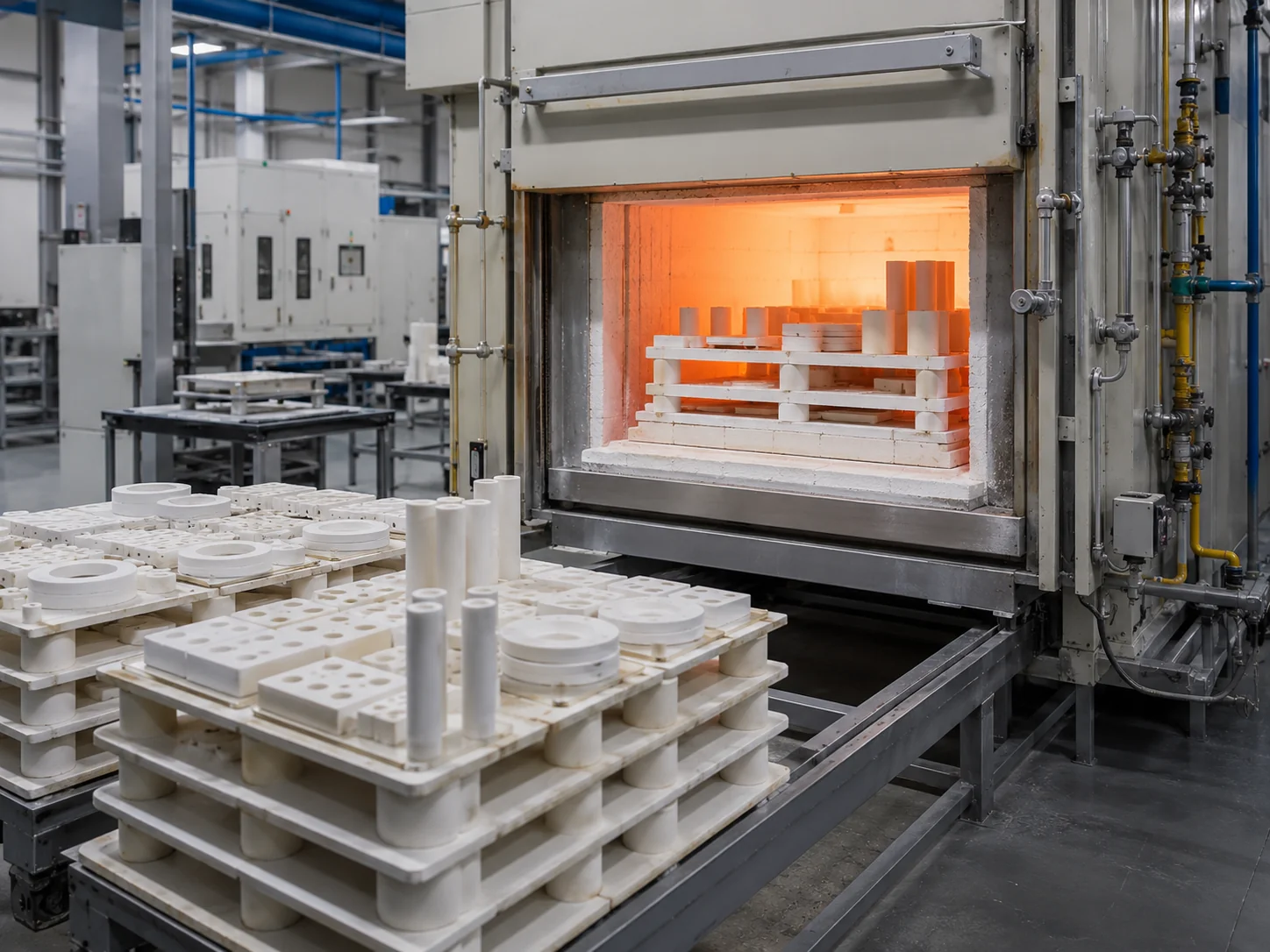
Debinding removes the organic binder from molded or pressed parts before sintering. The heating cycle is set so the binder is removed without cracking or changing the part geometry. Sintering follows, increasing density and developing the hardness, wear behavior, electrical properties, and thermal stability of the selected ceramic.
Debinding cycle
Heating is adjusted for the binder system and part section so the organics are removed without creating internal defects.
Sintering cycle
Heating rate, hold time, cooling, and furnace atmosphere are set for the ceramic material and the part structure.
Furnace loading
Setters and loading positions are chosen to manage shrinkage, distortion, and dimensional variation across the furnace load.

Precision Machining & Finishing
Some dimensions and features cannot be finished during forming. After sintering, those parts are ground or machined to the drawing, with the operation chosen for the ceramic hardness and part geometry. Mating faces and other working surfaces are finished for the way the component will be assembled and used.
Size and geometry
Grinding brings diameters, thicknesses, flat surfaces, and mating faces to final size. Drilling, slotting, chamfering, and edge work are added where the drawing calls for them.
Working surfaces
Sealing, sliding, positioning, and contact surfaces receive the finishing needed for their function in the assembly.
Production Equipment & Process Support
The production floor combines forming equipment, debinding and sintering furnaces, machining machines, inspection stations, fixtures, and handling tools. Each type of equipment has a defined place in the route. Workholding and handling setups keep ceramic parts supported as they move between operations.
Forming and thermal equipment
Presses and molding equipment cover different forming routes, while debinding and sintering furnaces run the heating cycles required by each ceramic system.
Machining and measurement
Precision machining equipment completes features after firing, and dimensional inspection stations check the finished geometry against the drawing.


Product-Specific Manufacturing Capabilities
There is no single process route for every ceramic part. A tube, flat wear plate, and multi-hole structural component place different demands on forming, furnace support, machining, and inspection. The route is built around the geometry that must survive firing and the surfaces that must meet the finished drawing.
Tubes and sleeves
Bore size, wall thickness, straightness, and concentricity determine the forming and finishing sequence.
Rings, plates, and wear parts
Flatness, contact surfaces, edge condition, and wear-zone geometry guide the loading, grinding, and inspection steps.
Complex structural parts
Multi-hole, slotted, stepped, and irregular components use a combination of forming and post-sintering machining selected for the actual geometry.