

Industry Ceramics
High-Precision Industrial Technical Ceramic Components
Custom Ceramic Parts for Robotics, Factory Automation, and Textile Machinery
We manufacture precision technical ceramic components engineered for extreme industrial environments. Utilizing advanced oxide and non-oxide ceramic materials—principally High-Purity Alumina (Al₂O₃ 99%), Yttria-Stabilized Zirconia (YSZ), and Hot-Pressed Silicon Nitride (Si₃N₄)—our components deliver exceptional wear resistance, thermal stability, and electrical insulation.
Backed by over 15 years of ceramic engineering experience, our production overcomes traditional high-temperature shrinkage challenges through precise green-body machining and compensated tooling design. From dry pressing and isostatic pressing to high-temperature sintering and diamond grinding, we deliver reliable performance for OEM equipment builders operating under high friction, corrosion, and thermal loads.
-
![Ceramic Parts for Robots]() Ceramic Parts for RobotsCeramic parts for robots are precision zirconia components used for structural, wear, guide, insulating, and positioning functions inside robotic mechanisms. Applications include industrial...read more
-
![Ceramic Yarn Guide]() Ceramic Yarn GuideA ceramic yarn guide is a zirconia part that controls yarn direction through textile machinery. It is used in winding equipment, bobbin and rewinding machines, spinning lines, automatic yarn...read more
-
![Ceramic Spray Nozzle]() Ceramic Spray NozzleA ceramic spray nozzle is a zirconia flow-control part that directs liquid or air through a defined orifice. Applications include textile humidification, photovoltaic dust removal and air blowing,...read more
-
![Robot Ceramic Joints]() Robot Ceramic JointsOur Robot Ceramic Joints are manufactured using zirconia as the core raw material, processed through injection molding, high-temperature sintering, and multi-stage precision machining. The...read more
-
![Textile Ceramic Yarn Guides]() Textile Ceramic Yarn GuidesTextile ceramic yarn guides are zirconia routing parts for continuous high-speed yarn handling. They are used in spinning machines, texturing machines, circular and warp knitting machines, weaving...read more
-
![Automation Ceramic Parts]() Automation Ceramic PartsAutomation ceramic parts are zirconia components used for wear, guiding, insulation, locating, and structural functions in automated equipment. They are applied in intelligent production lines,...read more
-
![Textile Ceramic Parts]() Textile Ceramic PartsTextile ceramic parts are zirconia components used for wear, positioning, yarn guiding, insulation, and structural functions in textile machinery. They are found in yarn-routing and threading...read more


Product Categories
Robotic Ceramic Parts
Insulation pins, alignment sleeves, welding locating pins, and vacuum gripper pads designed to withstand high mechanical repetition and thermal spatter without deformation.
Automation Ceramic Components
Precision wear plates, guide rails, ceramic rollers, and positioning blocks engineered for high-speed automated assembly lines and sliding mechanisms.
Textile Ceramic Parts
Thread guides, eyelets, pulleys, and traverse guides processed to ultra-low surface roughness (Ra) to prevent yarn friction abrasion at high operating speeds.
Advanced Ceramic Materials
Custom formulations and stock grades tailored for specific mechanical load, electrical isolation, and thermal requirements.
Key Specifications & Performance
|
Parameter |
Alumina (Al₂O₃ 99%) |
Zirconia (ZrO₂ - YSZ) |
Silicon Nitride (Si₃N₄) |
|
Density (g/cm³) |
≥ 3.89 |
≥ 6.00 |
≥ 3.20 |
|
Vickers Hardness (GPa) |
15 - 18 |
12 - 15 |
15 - 17 |
|
Fracture Toughness (MPa·m¹ᐟ²) |
3.5 - 4.5 |
8 - 10 |
6.5 - 7.0 |
|
Max. Operating Temp (°C) |
1600 |
1000 |
1000 (Non-oxidizing: 1400) |
|
Flexural Strength (MPa) |
300 - 380 |
900 - 1200 |
600 - 800 |
|
Surface Finish (Ra, μm) |
Down to 0.1 (Ground/Polished) |
Down to 0.05 |
Down to 0.05 |
Dimensions & Tolerances: As-sintered linear tolerances typically ±1% to ±2%. Post-sintering precision CNC diamond grinding achieves outer/inner diameters and thicknesses down to ±0.005 mm per engineering drawings.
Chemical & Corrosion Resistance: Chemically inert against strong acids, concentrated alkalis, and organic solvents across ambient and elevated operating temperatures.
Applications & Equipment Compatibility
Industrial Robotics
Integrated into multi-axis assembly robots for electrical insulation and wear-resistant contact surfaces in welding and handling jigs.
Automated Assembly Systems
Installed in high-cycle sorting tracks, indexing tables, and pick-and-place fixtures where strict dimensional stability prevents operational jamming.
Textile Machinery
Utilized in spinning frames, winders, and high-speed looms where continuous yarn contact demands extreme abrasion resistance to eliminate grooving wear.

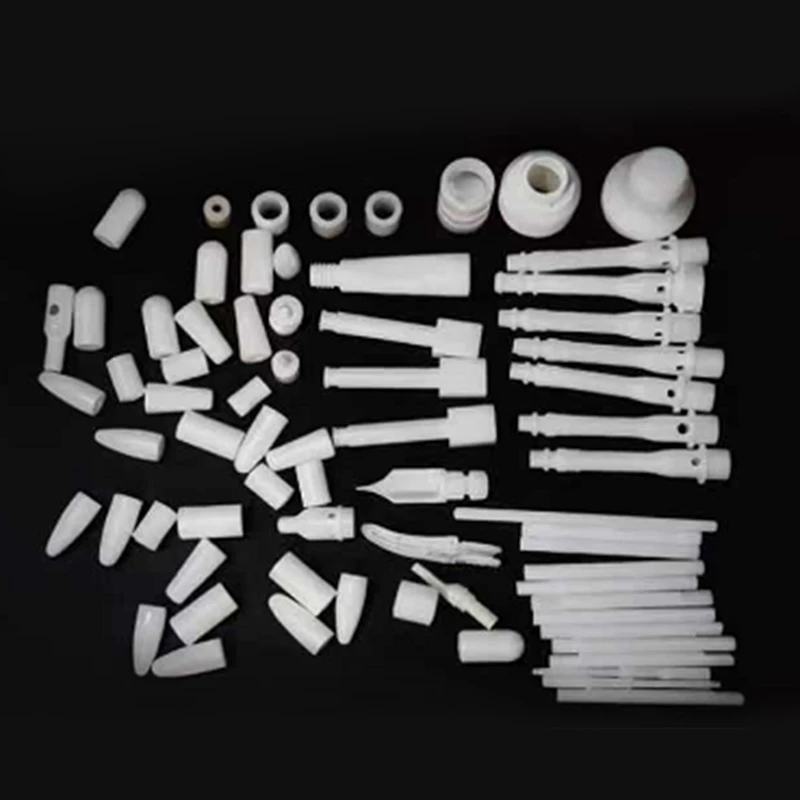
We produce components strictly to customer specifications from CAD files (STEP, IGES, PDF) and material data sheets.
Material Matching: Engineering team evaluates mechanical stress, thermal shock profiles, and sliding friction rates to select the optimal ceramic grade.
Shrinkage Control & Green Machining: Complex geometries are pre-machined in the green or pre-sintered state, utilizing calculated volumetric shrinkage compensation factors to ensure net-shape accuracy.
Hard Machining: Post-sintering CNC grinding, ultrasonic machining, and diamond core drilling achieve strict final tolerances and complex internal features.
OEM/ODM Support: Full-scale prototype fabrication, pilot batch runs, and dedicated contract manufacturing for industrial machinery builders.
Manufacturing & Quality Control
Our in-house operations maintain strict process control from raw powder preparation to final inspection, operating under ISO 9001 quality management standards:
Forming & Sintering
Multi-axis uniaxial pressing, cold isostatic pressing (CIP), and computer-controlled atmosphere kilns ensure uniform microstructural densification and eliminate internal micro-voids.
Dimensional Inspection
100% verification capabilities using CMM (Coordinate Measuring Machines), laser micrometers, and optical comparators. Material test reports (MTR) and dimensional inspection sheets are available upon request.
Precision Processing
Dedicated CNC surface grinders, cylindrical grinders, and diamond wire saws maintain micro-level dimensional compliance.
Batch Consistency
Strict lot traceability from raw material powder batching through final sintering and grinding parameters.
Frequently Asked Questions

Request a Quote
To receive an accurate technical evaluation and commercial quotation, please provide the following details:
Engineering Drawings: CAD files (STEP/IGES) or dimensioned PDF drawings.
Material Specifications: Preferred ceramic material or operational parameters (temperature, load, friction medium, chemical exposure).
Application Details: Equipment type and specific working environment.
Quantity: Estimated annual volume, batch size, or prototype quantity.
We are one of the most experienced industry ceramics manufacturers and suppliers in China, also support customized service. Welcome to buy high quality industry ceramics made in China here and get pricelist from our factory. For price consultation, contact us.
Ceramic Parts For Robots, Ceramic Yarn Guide, Textile Ceramic Parts