

As a supplier of ceramic parts, ensuring the quality of our products is of utmost importance. In this blog, I will share some key strategies and practices that we adopt to guarantee the high - quality of ceramic parts.
1. Raw Material Selection
The quality of ceramic parts starts with the raw materials. We carefully select high - purity raw materials to ensure the consistency and performance of the final products. For instance, when producing Zirconia Ceramic Components, we source zirconia powders with specific particle sizes and chemical compositions. These raw materials are thoroughly tested for impurities, moisture content, and particle size distribution.
We work closely with reliable suppliers who can provide us with consistent quality raw materials. Regular audits of our suppliers' facilities and quality control systems are conducted to ensure that they meet our strict standards. By using high - quality raw materials, we can reduce the likelihood of defects such as porosity, cracks, and inconsistent mechanical properties in the ceramic parts.
2. Precision Manufacturing Processes
2.1 Forming
The forming process is crucial in determining the shape and initial structure of the ceramic parts. We use various forming methods, including dry pressing, injection molding, and slip casting, depending on the complexity and requirements of the parts.
In dry pressing, we carefully control the pressure and the particle packing of the raw materials to ensure uniform density throughout the part. For injection molding, we optimize the injection parameters such as temperature, pressure, and injection speed to avoid issues like air entrapment and uneven filling. Slip casting requires precise control of the slurry properties, such as viscosity and solid content, to achieve a smooth and defect - free surface on the formed part.
2.2 Sintering
Sintering is a critical step in the manufacturing of ceramic parts as it densifies the material and enhances its mechanical properties. We use advanced sintering furnaces that can precisely control the temperature, heating rate, and atmosphere.
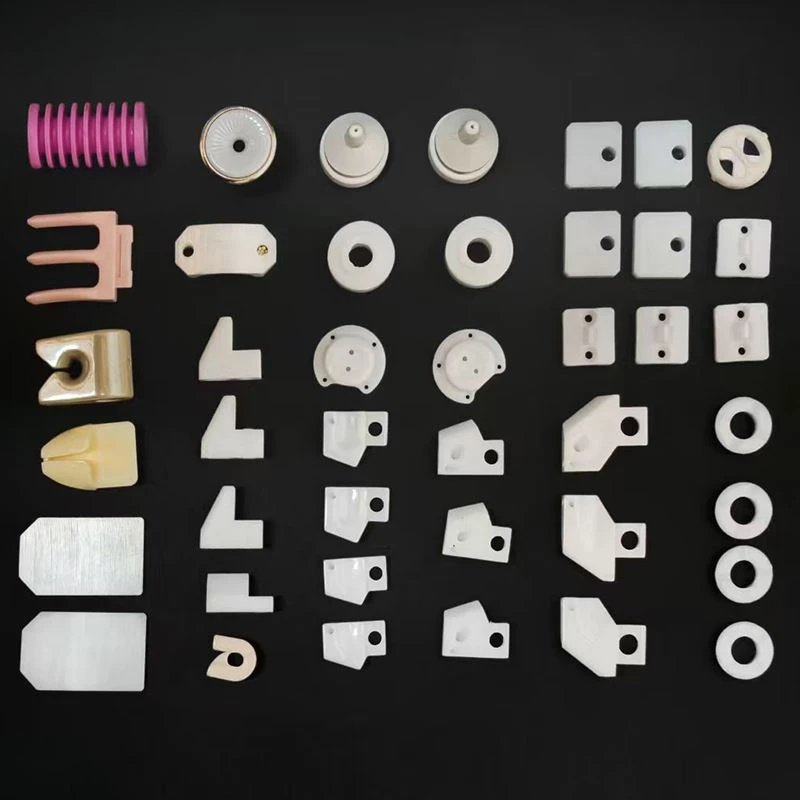

For example, in the sintering of Precision Ceramic Parts, we follow a well - defined sintering schedule. The heating rate is carefully adjusted to prevent thermal shock and cracking. The sintering atmosphere, whether it is air, nitrogen, or vacuum, is selected based on the material properties and the desired performance of the parts. After sintering, we conduct post - sintering treatments such as annealing to relieve internal stresses and improve the overall quality of the parts.
3. Quality Control at Every Stage
3.1 In - process Inspection
We implement in - process inspection at every stage of the manufacturing process. This includes visual inspection, dimensional measurement, and non - destructive testing. For visual inspection, trained operators carefully examine the parts for surface defects such as scratches, chips, and cracks.
Dimensional measurement is carried out using precision measuring tools such as calipers, micrometers, and coordinate measuring machines (CMM). This ensures that the parts meet the specified tolerances. Non - destructive testing methods, such as ultrasonic testing and X - ray inspection, are used to detect internal defects that may not be visible to the naked eye.
3.2 Final Inspection
Before the ceramic parts are shipped to our customers, a comprehensive final inspection is conducted. This includes a repeat of the dimensional and visual inspections, as well as additional performance tests.
For Corrosion Resistant Ceramic Parts, we perform corrosion tests in specific environments to ensure that they meet the required corrosion resistance standards. Mechanical property tests, such as hardness, strength, and toughness, are also carried out to verify the performance of the parts. Only parts that pass all the inspection and testing procedures are approved for shipment.
4. Employee Training and Skill Development
Our employees play a vital role in ensuring the quality of ceramic parts. We provide regular training programs to enhance their skills and knowledge in ceramic manufacturing and quality control.
New employees are given comprehensive on - the - job training to familiarize them with the manufacturing processes and quality standards. Experienced employees also participate in continuous training programs to keep up with the latest technologies and best practices in the industry. By investing in employee training, we can improve the overall quality of our products and reduce the likelihood of human - error - related defects.
5. Research and Development
We continuously invest in research and development to improve the quality and performance of our ceramic parts. Our R & D team works on developing new materials, manufacturing processes, and quality control methods.
For example, we are researching new ceramic compositions that can offer better mechanical properties, higher corrosion resistance, and improved thermal stability. We are also exploring new manufacturing techniques that can reduce production costs while maintaining high quality. By staying at the forefront of technological advancements, we can provide our customers with the best - quality ceramic parts.
6. Customer Feedback and Continuous Improvement
We value our customers' feedback and use it as a valuable source of information for continuous improvement. We encourage our customers to share their experiences with our products, including any issues or suggestions for improvement.
Based on the customer feedback, we analyze the root causes of the problems and implement corrective actions. This may involve adjusting the manufacturing processes, improving the quality control procedures, or developing new products to meet the customers' specific needs. By continuously improving our products and services, we can enhance customer satisfaction and build long - term relationships with our customers.
Contact for Procurement
If you are interested in purchasing high - quality ceramic parts, we would be delighted to discuss your requirements. Our team of experts is ready to provide you with detailed information about our products, manufacturing processes, and quality control measures. We can offer customized solutions to meet your specific needs. Please feel free to reach out to us for a procurement discussion.
References
- Smith, J. (2018). Ceramic Materials Science and Engineering. Wiley.
- Jones, A. (2020). Quality Control in Ceramic Manufacturing. Elsevier.
- Brown, C. (2019). Advanced Ceramic Manufacturing Techniques. Springer.