

As a supplier of precision ceramic parts, I often encounter inquiries about various properties of ceramics, and one of the frequently asked questions is the dielectric constant. The dielectric constant, also known as relative permittivity, is a crucial parameter that can significantly influence the performance of precision ceramic parts in different applications. In this blog, we'll explore the concept of the dielectric constant in the context of precision ceramic parts, looking at its importance, factors affecting it, and how it relates to our product offerings.
Understanding the Dielectric Constant
The dielectric constant ($\epsilon _r$) of a material is a measure of how much electrical energy a dielectric material can store when placed in an electric field compared to a vacuum. Mathematically, it is the ratio of the permittivity of the material ($\epsilon$) to the permittivity of free space ($\epsilon_0$), where $\epsilon_0 \approx 8.854 \times 10^{-12}$ F/m. A high dielectric constant indicates that the material can store more electrical energy for a given electric - field strength.
In precision ceramic parts, the dielectric constant plays a vital role in applications involving electrical insulation or capacitive behavior. For example, in Ceramic Electronic Components, such as capacitors, a high dielectric constant allows for the design of smaller and more efficient components. Capacitors store electrical energy, and a higher dielectric constant ceramic can achieve a higher capacitance per unit volume, which is highly desirable in modern, miniaturized electronic devices.
Factors Affecting the Dielectric Constant of Precision Ceramic Parts
Material Composition
The chemical composition of the ceramic is the most fundamental factor influencing the dielectric constant. Different ceramic materials have different atomic and molecular structures, which determine how they interact with an electric field. For instance, barium titanate ($BaTiO_3$) is a well - known ceramic with a very high dielectric constant, making it a popular choice for capacitor applications. On the other hand, alumina ($Al_2O_3$) ceramics generally have a lower dielectric constant, which makes them suitable for high - frequency insulation applications where a stable and relatively low dielectric constant is required.
Temperature
Temperature can have a significant impact on the dielectric constant of precision ceramic parts. In many cases, the dielectric constant changes with temperature in a non - linear manner. For example, some ferroelectric ceramics, like lead zirconate titanate (PZT), exhibit a sharp peak in the dielectric constant at their Curie temperature. Above this temperature, the material loses its ferroelectric properties, and the dielectric constant decreases rapidly. Understanding the temperature - dependence of the dielectric constant is crucial for applications where temperature variations are expected, such as in automotive or aerospace electronics.
Frequency
The frequency of the applied electric field also affects the dielectric constant. As the frequency increases, the ability of the ceramic's dipole moments to align with the changing electric field becomes limited. This can lead to a decrease in the dielectric constant at high frequencies. For high - frequency applications, such as microwave circuits, it is essential to select ceramic materials with a stable dielectric constant over the operating frequency range.
Porosity and Microstructure
The porosity and microstructure of the ceramic can influence the dielectric constant. Porous ceramics have a lower dielectric constant compared to dense ceramics because the pores are filled with air, which has a dielectric constant close to 1. Additionally, the grain size and grain boundary characteristics in the ceramic microstructure can affect the movement of charge carriers and the alignment of dipoles, thereby influencing the dielectric behavior.
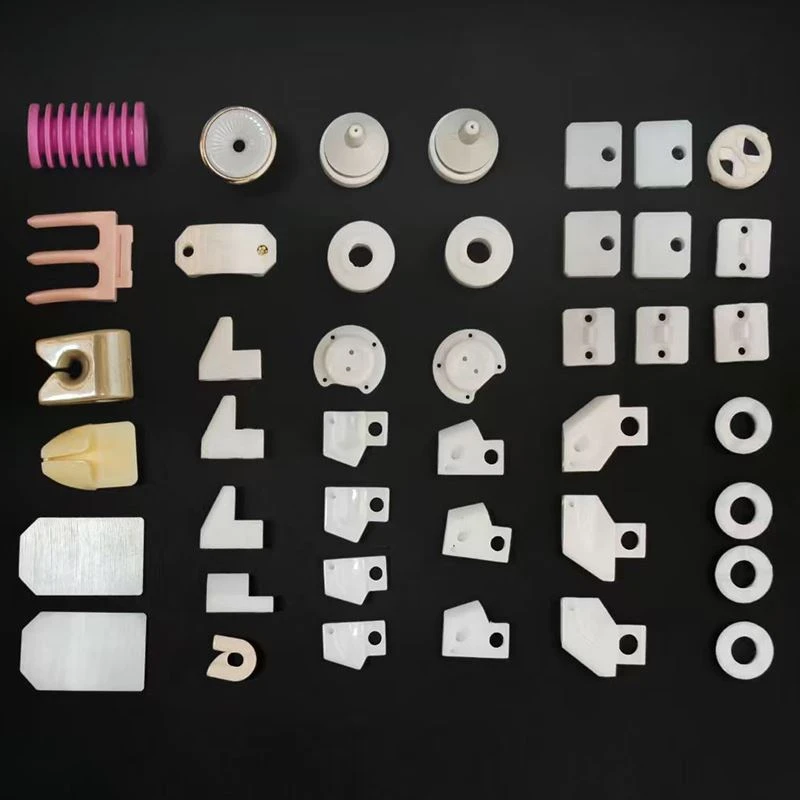

Dielectric Constant in Different Types of Precision Ceramic Parts
Zirconia Ceramic Parts
Zirconia ceramics are known for their high strength, toughness, and good chemical stability. In terms of the dielectric constant, zirconia typically has a moderate value. It is often used in applications where mechanical properties are critical, such as in cutting tools and bearings. However, in some electronic applications, the dielectric properties of zirconia can also be exploited. For example, in certain high - power electronics, zirconia can serve as an insulating material with stable dielectric properties.
Corrosion Resistant Ceramic Parts
Ceramics that are highly resistant to corrosion, such as silicon carbide (SiC) and some glass - ceramics, also have specific dielectric constants. These parts are commonly used in harsh chemical environments. The dielectric constant of these materials can be important in applications where they are used in electrical or electronic systems that are exposed to corrosive substances. For instance, in chemical sensors, the dielectric constant can change in response to the presence of certain chemicals, which can be used for sensing purposes.
Industrial Ceramic Components
In industrial applications, precision ceramic components are used in a wide range of equipment, from machinery to electrical systems. The dielectric constant can play a role in different scenarios. For example, in electrical insulation for high - voltage equipment, ceramics with a low and stable dielectric constant are preferred to prevent excessive electrical losses. In heating elements, although the primary focus is on thermal properties, the dielectric constant can still be relevant for electromagnetic compatibility and electrical safety.
Heat Resistant Ceramic Parts
Heat - resistant ceramics, such as alumina and certain refractory ceramics, are designed to withstand high temperatures. Their dielectric constant behavior at elevated temperatures is of particular interest. For applications like high - temperature sensors or furnace insulation where electrical properties may need to be maintained, understanding how the dielectric constant changes with temperature is essential.
Importance of Controlling the Dielectric Constant
Controlling the dielectric constant of precision ceramic parts is crucial for ensuring consistent performance in various applications. In the field of electronics, even a slight variation in the dielectric constant can lead to significant changes in the performance of electronic components. For example, in a capacitor - based circuit, an inaccurate dielectric constant can cause the capacitance to deviate from the desired value, affecting the circuit's frequency response and signal integrity.
In our manufacturing process, we employ strict quality control measures to ensure that the dielectric constant of our precision ceramic parts meets the specified requirements. This involves careful selection of raw materials, precise control of the sintering process, and thorough testing of the finished products. By maintaining tight control over the dielectric constant, we can provide our customers with reliable and high - performance ceramic components.
Concluding Thoughts and Call to Action
The dielectric constant is a fundamental property of precision ceramic parts that has a far - reaching impact on their performance in a wide range of applications. Whether you are looking for Ceramic Electronic Components with high - capacitance capabilities or Heat Resistant Ceramic Parts with stable dielectric properties at elevated temperatures, our company is dedicated to providing you with the best - quality precision ceramic parts.
If you are interested in our precision ceramic parts and would like to learn more about their dielectric properties or discuss your specific requirements, we encourage you to get in touch with us for procurement and further discussions. Our team of experts is ready to provide you with detailed technical information and support to help you make the best choices for your applications.
References
- "Introduction to Ceramics" by W. D. Kingery, H. K. Bowen, and D. R. Uhlmann.
- "Dielectric Materials and Applications" by M. E. Lines and A. M. Glass.
- "Ceramic Materials: Science and Engineering" by J. Reed.