

Hey there! As a supplier of Ceramic Electronic Components, I'm super stoked to chat about the frequency response characteristics of these nifty little things. Ceramic electronic components are all around us, from our smartphones to complex industrial machinery. Understanding their frequency response is key to making the most of them in different applications.
Let's start with what frequency response actually means. In simple terms, it's how a component reacts to different frequencies of an electrical signal. You know how some speakers sound better at low frequencies (bass) and others at high frequencies (treble)? Well, ceramic electronic components have their own "sweet spots" too when it comes to frequencies.
One of the most common ceramic electronic components is the ceramic capacitor. These bad boys are used in a ton of circuits to store and release electrical energy. Their frequency response is pretty interesting. At low frequencies, ceramic capacitors act like a short - circuit to DC (direct current) and offer a high impedance to AC (alternating current). But as the frequency increases, their impedance starts to drop. This is because the capacitance value of a ceramic capacitor is frequency - dependent.
The dielectric material in ceramic capacitors plays a huge role in their frequency response. Different types of ceramics have different dielectric constants, which affect how the capacitor behaves at different frequencies. For example, Class 1 ceramic capacitors, which are made from materials like C0G (NP0), have a very stable capacitance over a wide range of frequencies. They're great for applications where frequency stability is crucial, like in oscillators and filters.
On the other hand, Class 2 ceramic capacitors, such as X7R or Y5V, have a higher capacitance density but are less stable with frequency. Their capacitance can change significantly as the frequency goes up. So they're more commonly used in bypass and coupling applications where a precise capacitance value isn't as critical.
Ceramic inductors are another important type of ceramic electronic component. These are used to store energy in a magnetic field and are often found in power supplies and RF (radio frequency) circuits. The frequency response of ceramic inductors is related to their self - resonant frequency. At frequencies below the self - resonant frequency, the inductor behaves like an inductor, offering inductive reactance. But as the frequency approaches the self - resonant frequency, the impedance of the inductor increases and reaches a maximum at the self - resonant frequency. Above this frequency, the inductor starts to behave more like a capacitor.
Ceramic resistors also have their own unique frequency response characteristics. Unlike ideal resistors that have a constant resistance regardless of frequency, real - world ceramic resistors can have some frequency - dependent effects. At high frequencies, the parasitic capacitance and inductance of the resistor can cause the effective resistance to change. This is especially important in high - speed circuits where even small changes in resistance can affect the performance of the circuit.
When it comes to choosing the right ceramic electronic component for a particular application, understanding its frequency response is crucial. For example, if you're designing a high - speed digital circuit, you'll want to choose ceramic capacitors with a flat frequency response and low equivalent series resistance (ESR). This ensures that the capacitor can handle the rapid changes in voltage and current in the circuit.
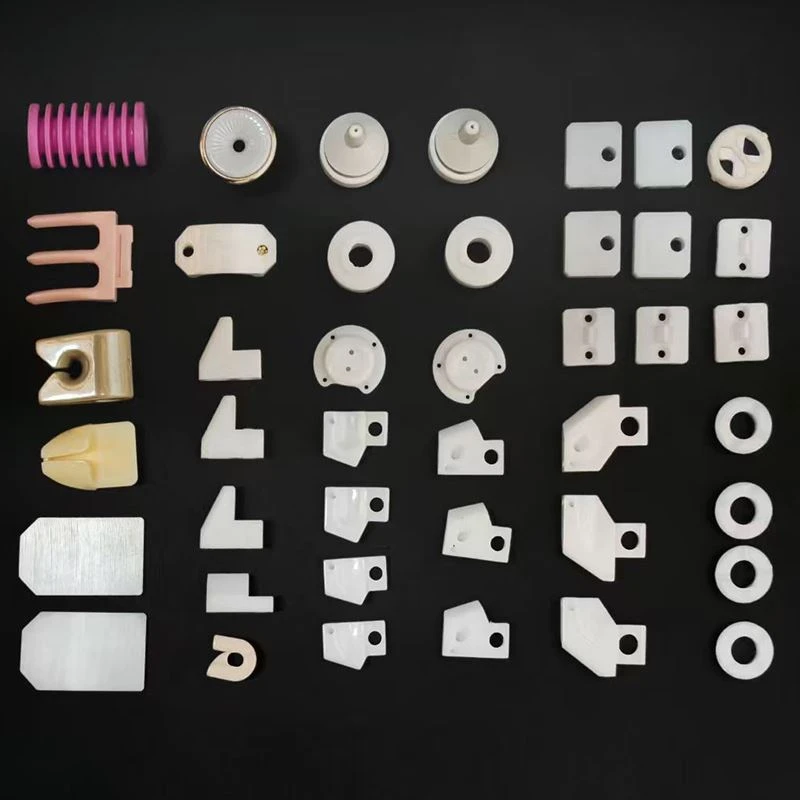
For RF applications, you'll need ceramic components that are optimized for high - frequency performance. Industrial Ceramic Components can be a great option here. They're designed to have low losses and high stability at RF frequencies. Our Ceramic Electronic Components are specifically engineered to meet the demands of different frequency ranges, whether it's for consumer electronics or industrial applications.
Precision is often a big factor in electronic design. That's where Precision Ceramic Parts come in. These components are made with high - quality ceramics and manufacturing processes to ensure consistent and accurate performance. Their frequency response characteristics are tightly controlled, making them ideal for applications where precision is key, like in medical devices or aerospace electronics.
Zirconia ceramic components have some unique properties that make them stand out when it comes to frequency response. Zirconia Ceramic Components offer good mechanical strength and electrical insulation, which can be beneficial in high - frequency applications where reliability is important. They also have a relatively stable dielectric constant over a wide range of frequencies, which helps in maintaining consistent performance.
In industrial settings, Industrial Ceramic Parts are used in a variety of applications, from motors to power generation equipment. These components need to be able to handle different frequencies and environmental conditions. The frequency response characteristics of industrial ceramic parts are carefully designed to ensure they can perform well in these harsh environments.
If you're in the market for ceramic electronic components, it's important to work with a supplier who understands the intricacies of frequency response. We've spent years researching and developing our products to ensure they meet the highest standards of performance. Whether you're working on a small - scale project or a large industrial application, we have the right ceramic components for you.
So, if you're looking to buy high - quality ceramic electronic components, don't hesitate to reach out. We can help you choose the best components based on your specific frequency requirements. Whether it's for a new product design or a replacement part, we've got you covered. Let's start a conversation about how our ceramic electronic components can take your project to the next level.
References

- "Fundamentals of Electronic Devices" by Robert T. Paynter
- "Ceramic Materials for Electronics" edited by J. R. Kennedy
- Industry research reports on ceramic electronic components