


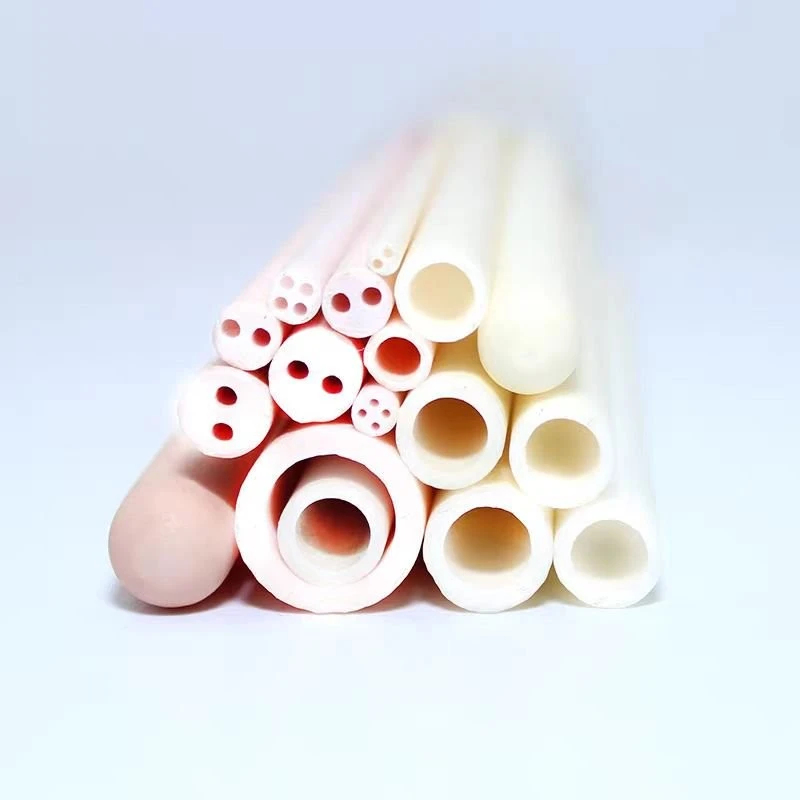
High Alumina Ceramic Parts are made from 92%-99.7% alumina. They are used in photovoltaic equipment, textile machinery, electrical insulation assemblies, wear interfaces, and general industrial equipment where the design specifies an alumina ceramic component.
Core Advantages
Hardness for Sliding and Abrasive Interfaces
The listed alumina grades have hardness of HV 1300-1600 and density of 3.6-3.95 g/cm³. This combination is used for guide surfaces, wear seats, sleeves, and other repeated-contact areas where surface loss can change the fit.
Mechanical Strength at Elevated Temperature
Flexural strength is specified at 300-550 MPa, and the listed maximum working temperature is 1600°C. Alumina supports and structural parts can therefore carry mechanical load in heated equipment without relying on the softening behavior of metals.
Electrical Insulation in Alumina Components
Volume resistivity is specified at >=10^14 ohm-cm. An alumina part can provide the required locating or support geometry while also electrically separating conductive hardware.
Customization
- Forming Route
Dry pressing and ceramic injection molding are available. The forming route is selected according to part geometry, wall section, and production requirements.
- Geometry and Mounting Features
Holes, slots, chamfers, curved surfaces, and mounting details can be made to the released drawing.
- Post-Sintering Finish
Specified contact, locating, or mating faces can be ground or polished after sintering.

Specifications
|
Parameter |
Specification |
|
Alumina Content |
92% - 99.7% |
|
Density |
3.6 - 3.95 g/cm³ |
|
Hardness (HV) |
1300 - 1600 |
|
Flexural Strength |
300 - 550 MPa |
|
Volume Resistivity |
≥10¹⁴ Ω·cm |
|
Max. Working Temperature |
1600℃ |
Quality Control
Raw material grade and batch identity are checked before forming. Green parts are inspected for shape and visible defects, while sintered parts are screened for cracking, deformation, edge damage, and other conditions that could affect final machining.
Density and hardness can be sampled by batch when the released requirement calls for these checks. Dimensional inspection then covers mating sizes, holes, slots, thicknesses, and finished surfaces identified as control points on the drawing.
Final inspection covers appearance, accepted dimensions, quantity, and cleanliness before packing. The approved drawing, specification, or confirmed sample remains linked to the inspection record for repeat-order traceability.
FAQ
Q: Can you provide a prototype before repeat production?
A: Yes. A prototype can be produced and checked before the repeat-production specification is released.
Q: What payment terms are available?
A: Standard orders use 30% deposit and 70% balance after acceptance; custom-made orders use 50% deposit and 50% balance.
Q: Do repeat orders normally have a shorter lead time?
A: Yes. Repeat-order lead times are normally shorter after the first approved batch.
Q: Can one order include different alumina purity grades?
A: Yes. Different alumina grades can be combined when agreed for the order.
Hot Tags: high alumina ceramic parts, China high alumina ceramic parts manufacturers, suppliers, factory, aluminum nitride ceramic components, ceramic pins, ceramic rods, ceramic shafts, Industrial Ceramic Components, silicon nitride ceramic components


