

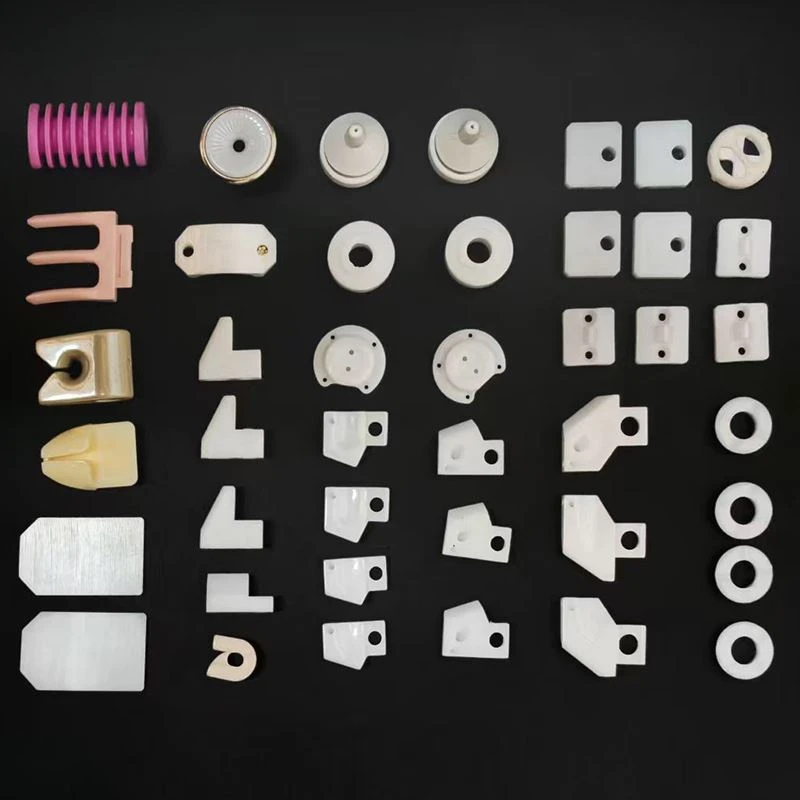
Wear Resistant Ceramic Components are made from 95% or 99% alumina, or zirconia, for locations exposed to continuous abrasion, particle erosion or repeated sliding. Common forms include guides, sleeves, plates, rings and other wear interfaces in material-handling, textile and automation equipment.
Core Advantages
1300–1700 HV with Wear Volume ≤0.02 cc
Hardness is 1300–1700 HV and ASTM wear volume is ≤0.02 cc. In abrasive sliding or particle-contact areas, these values indicate low material removal at the guide, liner or contact profile compared with a softer wear surface.
2000–3500 MPa Compressive Strength
Compressive strength is 2000–3500 MPa. Loaded sleeves, support pads, liners and contact faces resist crushing and local compressive damage when high pressure is combined with abrasion.
Working Range from -50 to 1500°C
The service range is -50 to 1500°C. The same wear component can be used in cold process areas and elevated-temperature equipment without changing material solely because the machine operates outside normal ambient temperature.
Customization
- Wear Material
Available materials are 95% alumina, 99% alumina and zirconia. Grade selection depends on whether abrasion, impact, insulation or a combination of these conditions dominates the wear zone.
- Part Form
Sleeves, plates, rings, guides, blocks and other non-standard wear components can be made to drawing. Geometry can be developed around the actual contact path, mounting method and replacement envelope.
- Wear-Surface Geometry
Bores, flatness, edge condition, grooves, contact faces and local wear tracks can be ground or otherwise finished to the drawing. Machining is concentrated on the surfaces that carry abrasive contact.
Specifications
|
Parameter |
Specification |
|
Material Types |
95%/99% Alumina, Zirconia |
|
Density |
3.6 - 6.0 g/cm³ |
|
Hardness (HV) |
1300 - 1700 |
|
Wear Volume (ASTM) |
≤0.02 cc |
|
Compressive Strength |
2000 - 3500 MPa |
|
Working Temp. Range |
-50 - 1500℃ |
Quality Control
Control starts with the ceramic powder route and continues through sintering. Controlled tunnel-kiln processing is used for this product line before the final wear surfaces are machined, with density and microstructure managed through the firing process.
Final dimensional inspection covers wear-zone geometry, bores, flat faces, guide tracks, mounting dimensions and contact surfaces. The working interface is checked directly instead of accepting the part from outside dimensions alone.
Finished wear components are inspected before packing, and accepted results are retained with the production batch. Parts with dimensional deviation, chips or surface damage outside the released requirement are separated before shipment.
FAQ
Q: What is the MOQ for Wear Resistant Ceramic Components?
A: There is no fixed MOQ; order quantity can be negotiated.
Q: Which shipping terms are available?
A: EXW, FOB and DDP can be arranged according to the contract.
Q: Can alumina or zirconia wear components also provide electrical insulation?
A: Yes.
Q: Do these ceramic wear components require anti-rust coating?
A: No.
Hot Tags: wear resistant ceramic components, China wear resistant ceramic components manufacturers, suppliers, factory, ceramic parts, ceramic rollers, ceramic sleeves, Heat Resistant Ceramic Parts, Industrial Ceramic Parts, silicon carbide ceramic parts


